


Shanghai Baoting Intelligent Technology Co., Ltd., established in May 2019, develops and manufactures BEKE Coffee equipment for self-service beverage retail. Our company-owned Shanghai operation brings cabinet engineering, automated equipment assembly and embedded control development into one manufacturing program.
The company's published intellectual-property portfolio includes 4 invention patents, 4 design patents, 17 utility-model patents and 24 software copyrights. Its invention patent CN118078095B covers an automatic powder-dispensing device for coffee vending machines, reflecting product development at the dispensing-mechanism level as well as in the user interface.
Manufacturing Scope
Freshly Ground Coffee Vending Machines
Automatic systems integrate bean grinding, extraction, cup dispensing and touchscreen ordering. A selected touchscreen model completes its beverage cycle in approximately 30–50 seconds per cup, with hot-drink choices and sweetness selection handled on the display.
Multilingual Coffee Vending Machines
International configurations combine freshly ground coffee with selectable operating languages. BEKE's multilingual platform lists Chinese, English, Japanese and Korean among its interface options and accepts multiple payment methods for mixed-language venues.
Coffee, Beverage and Snack Combo Machines
Combined vending platforms pair freshly brewed coffee with packaged drinks, snacks or bakery items. The bread-and-coffee configuration supports ambient or cooled bread storage; its published reference unit measures 2,200 × 1,650 × 970 mm and weighs 420 kg.
Robotic Coffee Kiosks
Robotic-arm models add automated cup pickup, positioning and delivery. The published robotic-arm configuration has a 0.89 m² footprint, a 21.5-inch touch display, more than 20 beverage options and a stated service capacity of 150–200 cups per day.
OEM and ODM Manufacturing
We build approved equipment platforms with project-specific logos, cabinet colors, touchscreen content and drink recipes. ODM programs also cover interactive-system adaptation and beverage-program development; destination voltage and local payment integration are defined at the configuration stage.
Production Process
Specification and Engineering Release
For each model, engineering confirms cabinet dimensions, electrical input, water arrangement, beverage modules, operating languages and payment hardware. Released drawings and the approved configuration determine the parts and assembly sequence before work begins.
Cutting and CNC Component Preparation
Cutting machines and CNC equipment prepare metal panels, doors and structural parts for the selected cabinet. Openings and mounting positions are processed for dispensing outlets, controls, internal modules and service access.
Bending, Welding and Cabinet Construction
Bending machines shape the prepared panels, while welding equipment joins the cabinet frame and supporting structures. Doors, mounting points and access panels are assembled before the internal beverage equipment is installed.
Beverage and Dispensing System Installation
Grinders, brewing units, pumps, heaters, water lines and cup-handling mechanisms are fitted to the approved machine layout. Combination models receive additional vending modules; robotic configurations incorporate arm-motion and cup-positioning hardware.
Electrical and Payment Hardware Integration
Touchscreens, controllers, electrical wiring, payment interfaces and connectivity modules are installed and linked to the dispensing equipment. Power and signal connections are organized around the internal mechanisms and maintenance access points.
Software Configuration and Assembly Handover
Drink programs, interface languages, operating parameters and available cloud-management functions are loaded for the destination configuration. The integrated machine is then transferred to the designated testing area for the inspection sequence described below.

BEKE Coffee machines are inspected in a dedicated testing area before factory release. Technicians check cabinet alignment, door fit, wiring, fluid connections and moving-part clearance. Functional testing covers grinding, water delivery, heating, extraction, beverage volume, leakage and automatic cleaning. Models with refrigeration, ice makers or robotic arms receive additional checks for cooling, cup positioning and transfer accuracy. Final tests verify touchscreen response, cup dispensing, payment processing and network communication through a complete transaction. Certificates and inspection reports, including evaluations by the Shanghai Institute of Quality Supervision and Inspection Technology, are matched to the relevant machine model and destination market requirements.
Our Shanghai facility covers about 3,000 m², with four zones for production, R&D, testing, and intelligent storage, supported by automated production and the Yangtze River Delta supply network.
Standard production is scheduled against an approved machine specification and available components. OEM and ODM projects add an engineering approval stage for changes to enclosure design, payment interfaces, program logic, or regional electrical requirements. For multi-location rollouts, configurations can be grouped into staged production and dispatch batches.
Each order schedule confirms the configuration approval date, production allocation, assembly completion, testing release, and export handover. The committed dispatch date is based on the selected model, final specification, and shipment requirements in the project quotation.

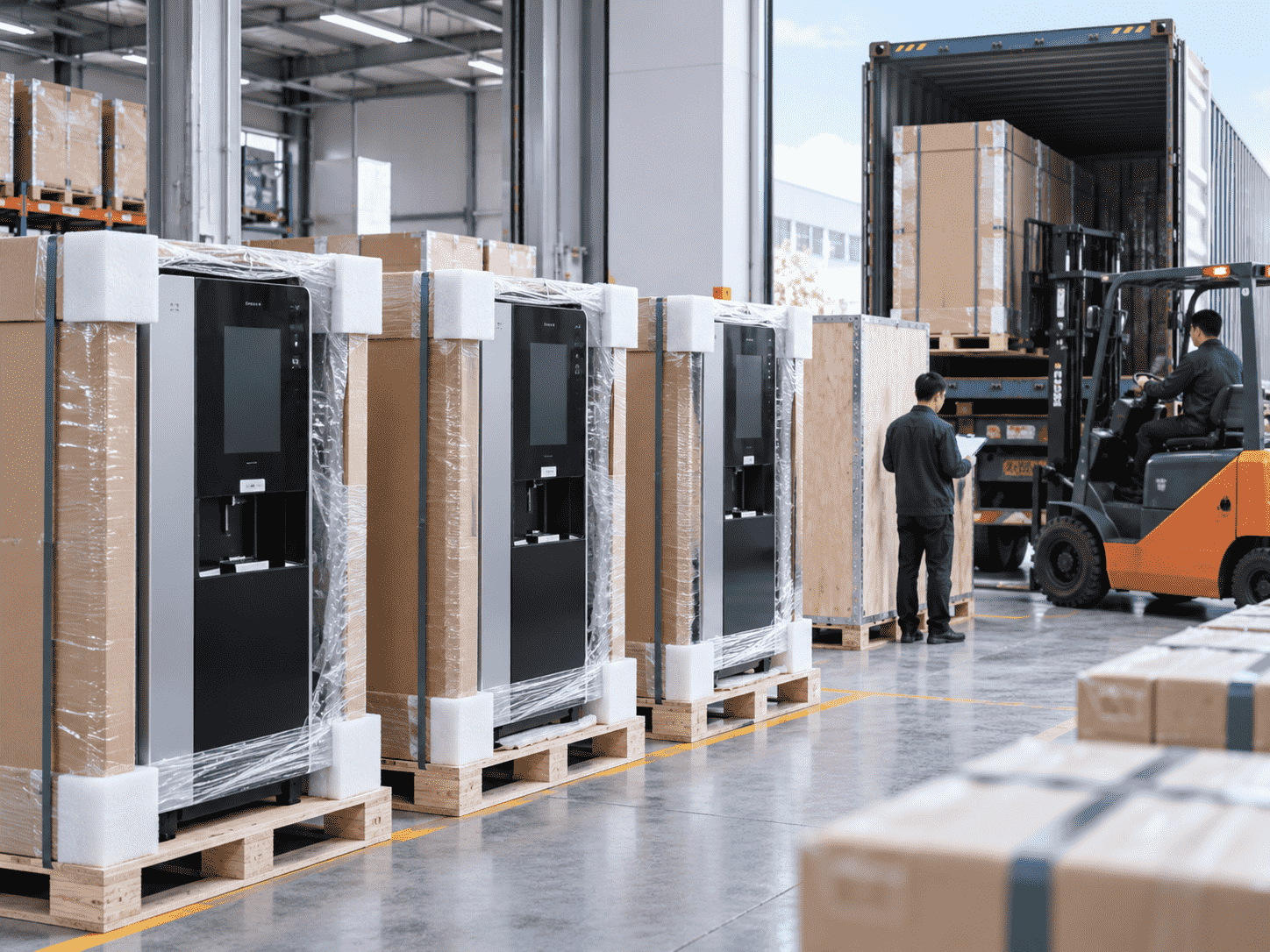
Export preparation is matched to the machine's size, weight and internal mechanisms. For its cashless-payment vending platform, BEKE specifies reinforced cartons, foam corner protection and wooden-pallet support to reduce impact during handling and international transport.
Shipment sets include operating information for overseas deployment, with multilingual user manuals, maintenance guides and troubleshooting materials available for the project. OEM/ODM programs can incorporate branded documentation. Our international logistics partners arrange door-to-door transport and shipment tracking, while the destination handover can include coordinated on-site installation and commissioning with local engineers.